 airt
airt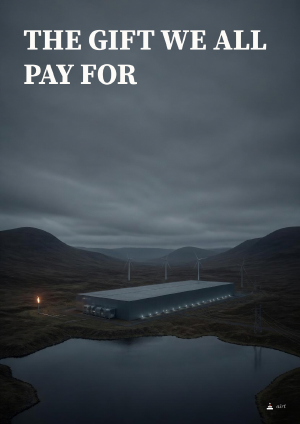
The Gift We All Pay For
Download PDFScotland is being asked to carry a wave of data-centre load on terms it never set. The gain is private, the cost arrives on your bill, and the meter that should sit between the two is switched off.
At Auchtertool in Fife a developer wants planning permission for 600MW of data centre drawing up to four terawatt-hours a year, comparable to the household electricity of around half the homes in Scotland, for a tenant it has not named and a use it will not specify. It sits on a site the council screened out of a full environmental assessment.1 There is no obligation in that application to supply its own firm power, none to shed when the system is short, none to fund the grid it will lean on.
Once built, it will be run by a few dozen technicians and security staff, not the ranks of engineers a data centre conjures in the mind.2 The gain is private and named; the load is public and nobody’s.
Metering that split is what a government is for, and here the meter is switched off. The fault is not that capital wants to build. It is that the ground arrives as a gift: permits fast-tracked, water law loosened, the public purse opened, and almost nothing asked back. A gift has no terms. What a 600MW load needs is a contract with teeth, and Scotland is not writing one.
Read the European Commission’s own words for the same machine at continental scale. The proposed Cloud and AI Development Act, tabled in June, calls for “at least tripling the EU’s data centre capacity within the next 5–7 years” by “simplifying and accelerating permitting” and improving “access to key resources such as energy, land, water and financing.”3 That is not a market outcome anyone can resist by shopping elsewhere. It is a state handing away energy, land and water by statute, on the promise of a future nobody has been asked to price.
The gatekeeper
Why gas? Big Tech has the money for power, and the cleanest, cheapest electrons on the system are the Scottish wind we currently pay to switch off. They are not choosing gas because it is green. They are choosing it because they cannot get onto the electricity grid in the time their capital allows. The UK’s gas networks fielded 113 connection enquiries from data-centre developers across 2024 and 2025, around three times as many in the second year as the first.4 A gas connection takes six to twenty-four months; the wire can be fifteen years away. Seven of those data centres have already secured their gas, 15.4 terawatt-hours between them, enough to heat 1.3 million homes. Ofgem now counts around a hundred gigawatts of data-centre projects queued for the grid.5
When the grid makes a buyer wait, a buyer with a building full of depreciating silicon does not. It defects, and burns gas behind the meter until the wire arrives, if it ever bothers to join the wire at all.6 The gas is a symptom of an ungoverned queue. Nobody is directing traffic, so the traffic routes around the grid and onto the gas main.
The optimistic case is that a data centre is flexible load, a sponge that can drink Scotland’s stranded wind and back off when the system is tight.7 The physics still holds in the surplus hours. But the newest careful work on how these machines actually behave is a caution against leaning on it too hard. Left to its own economics an AI data centre is baseload: the money is sunk in the chips, the chips lose value every month whether they compute or not, so the rational operator runs them flat out around the clock and is barely moved by the price of power.8
Flexibility is not a property of the load you can appeal to. It is a property the institution has to manufacture. Governments did exactly that for the last generation of ultra-heavy industry: interruptible tariffs that paid aluminium smelters to stand down when the grid was short, curtailment contracts, siting rules that put the load next to firm power. But the smelters shed because electricity was their dominant cost; an AI load, its money sunk in silicon, barely feels the price, so it cannot be paid to shed with cash, only with time. The flexibility that would let AI soak curtailed wind exists only if someone writes it into the connection agreement as a condition, trading a place nearer the front of the queue for a binding promise to shed. That is not a matter of appealing to the load’s better nature; it is governance, and it is exactly the governance we do not yet have.
Who pays
Since April 2023, the cost of managing grid constraints in Britain has fallen on consumers alone: generators stopped paying their share, so the price of a congested, over-committed grid is now invisible to the people whose investment decisions create the congestion.9 The system operator’s balancing bill for 2024/25 came to £2.7bn, of which £1.7bn was the cost of constraints, and it is forecast to climb toward £8bn a year by 2030 unless the network is built out a great deal faster.10 A new load that plugs into that grid without paying to reinforce it is not buying electricity at the market price. It is being handed a subsidy that arrives, quietly, on your bill. The load could, in principle, earn its keep by soaking the wind we pay to spill; but only in the hours it chooses to, and the baseload economics above leave it running flat out.
This is not a peculiarly British naivety. In the American PJM market, data-centre load accounted for $6.5bn of the $16.4bn in costs at the last capacity auction, forty per cent of the bill, and the market’s own monitor calls that load growth the primary reason for the price spike.11 The pattern travels because the design flaw travels: the load turns up, the public system absorbs the cost of keeping it fed, and the accounts are arranged so that no one has to look at the transfer.
Auchtertool is not the exception; it is the template. At least seventeen data centres are moving through Scotland’s planning system, from Auchtertool to Duns,12 and the flagship is the £8.2bn Lanarkshire growth zone the UK government announced in January, sold on a gigawatt of on-site renewables that turned out to exist mostly as a website, unveiled with no planning application yet on file. At South Gyle in Edinburgh a 213MW scheme was refused, the convener saying it would drive “a horse and coaches” [sic] through planning policy, and has appealed; the council’s own analysis put the jobs at thirty-nine.13 The framework that waves the rest through supports “green” data centres without ever defining the word, and the empty renewables promise, the undefined benefit and the consent that asks nothing back are anatomised at length in a companion essay.14 This is the design working as designed, not one bad application slipping through.
Here the gift likes to dress itself in a benefit, and the favourite costume is waste heat. The pitch writes itself: the data centre will warm local homes, schools, a hospital, Denmark does it, everyone wins. It is the cargo cult of Scottish data-centre planning. As the story goes, islanders who built runways out of straw after the war had watched the cargo planes land and reasoned backwards to the parts they could see, the airstrip and the control tower, and missed the thing that actually summoned the cargo. A waste-heat pledge does the same. It copies the surface of the Danish model, the sentence about warming homes, and skips the decades of municipal heat network that made the sentence true. The heat such a scheme offers comes as warm air from a sealed circuit, the lowest grade there is, into a country that carries almost none of its warmth through pipes.
Scotland’s own heat-network plan wants six terawatt-hours of supply by 2030. In 2025 heat networks supplied 1.57, up from 1.36 three years earlier, on about £14.5m of grant to seven projects.15 The benefit turns up with a bow on an empty box. A gift that costs the giver nothing is worth about what it costs.
The answer that gets reached for is refusal: reconsider our relationship with nature, dig none of it, resist. It mistakes the target. Decarbonisation is made of stuff. The copper, the lithium, the steel and the firm power are not optional extras of the green transition; they are the transition. “Reconsider our relationship with nature” is a fine sentence that declines to say where the copper comes from, and the unpaid part of that bill does not vanish when you stop looking at it. It lands, as these bills always do, not in Fife but in the Global South, on the people who never had the abundance being renounced: the household still cooking on a fire, the clinic with no cold chain.
Followed to its conclusion, the materials problem vindicates neither extraction without limit, which is how the frontline pays for the GPUs, nor a refusal that names no source for the copper. It vindicates governed extraction: materials pulled on terms, harm bounded, the benefit directed. The contract, seen from the raw-material end.
The one place someone said no
The one place an institution recently said no is Norway. In June its Supreme Court struck down the discharge permit for the Engebø mine, licensed to pipe its tailings into the Førdefjord, ruling that the permit breached the water-quality obligations Norway carries through the EEA.16 An environmental movement took the state to its highest court over a mine, and won.
And it won on the substance, not a technicality. The economic case for the mine, the tax take and the jobs, could not in themselves outweigh the water law: ordinary commercial returns and ordinary employment, the Court held following the EFTA court, do not clear the bar for wrecking a fjord. That is the veto worth wanting, one that bites the thing itself and not the label on the form.
It still does not stop the machine. A court rules only on the case in front of it, and this one expressly left open whether a fresh permit, grounded not in jobs but in critical-minerals supply security, might yet pass; the state had already reached for that coat, recasting the mine’s titanium as strategic supply. And the ruling stopped nothing on the ground: it forced a reassessment, not a halt. The campaigners who won it had to demand an immediate stop to the tailings still going into the fjord, and the company answered that it expected strong government backing to secure the permit and keep the project going regardless.17 The court voided the permit; the counterparty just waited for the next one, while the free-trade area’s surveillance authority challenges the Norwegian rules that allow it, through stages that will grind on for years.18
So the warning to Scotland is double. Teeth that clamp a form are teeth a good lawyer files off; only a real public-interest test, one that weighs the substance and can find it wanting, holds at all. But even that test judges only the case put to it, and a determined counterparty comes back in a better-dressed coat. Build the teeth, and the stamina to bite twice.
The contract, and whether we could write one
The answer is not the bolted door, and it is not the developer’s open one. Scotland has lately reached for both: the SNP’s national council passed a motion this month calling for a freeze on all new data centres, a request now sitting with ministers,19 even as the applications keep coming. A moratorium and a gift are the only two moves on the board, and neither is the one worth making.
It is a contract with teeth, and the terms are not exotic. Scotland can attach most to a consent tomorrow, within its own devolved competence: firm low-carbon power, built or bought, so the load neither quietly conscripts the public grid nor defaults to the gas main on a windless night; a decommissioning bond posted up front, so the public is not left holding a dead shed; a community-benefit fund paid in hard cash per megawatt, the five thousand pounds a megawatt a year Scotland already pays on onshore wind,20 not a slice of a profit the accountants can spirit offshore, and not a pub and a press release; and a public-interest test that examines the substance of the thing, the tenant, the use, the water, the firm power, and can actually say no. One term is not in that gift: making the developer fund the grid reinforcement its load requires, rather than socialise it onto every domestic bill, runs through the connection and balancing regime Ofgem sets and Westminster reserves, not a planning consent. That list is the meter, switched back on. Not “no data centres.” Nor as a gift.
Someone will say the hyperscalers would never stand for it, and they are right, and it does not matter. Constraint on concentrated capital has never in the history of the thing arrived by consent. The Factory Acts, the break-up of Standard Oil, the Glasgow rent strikes21: taken, not granted, usually in the wreckage after a crisis. To make their agreement the precondition for acting is to concede the game before it starts. The surrender is concrete: no national plan for the loads the country is being asked to carry, and no public funding at the scale the firm power behind them needs.
The powerful are spending serious political capital to write their claim into statute, and to fast-track data centres past the permitting that would otherwise slow them. You do not lobby that hard to defang a veto that has no teeth. The effort to enclose the thing is the market’s own valuation of what is being enclosed.
The balance sheet is bad enough, but it is not the deepest problem. Writing a contract, and enforcing it, is a thing a state has to be able to do, and that ability is what Scotland is missing. Norway can drag its own government to the Supreme Court and beat it on the substance; that is a country with the institutional muscle to have the fight in the first place.
A Scotland that can screen a 600MW load out of an environmental assessment, let an application with no named tenant run, and hand away its energy, land and water on the promise of a pub, is not a country being clever about capital. It is a country that has only learned to give. And the failure runs deeper than any overrun. The last time it placed a shipbuilding order of any ambition, it ordered two first-of-their-kind ferries, the UK’s first designed to run on LNG, from a yard just rescued from administration, on a fixed price that waived the standard builder’s refund guarantee, a risk its own procurement body protested quietly behind closed doors and ministers accepted; the novel gas system it was built around was not made to work in time, and the first of them was delivered years late, running on diesel.22
The constitutional question everyone wants to argue about, the leap, the flag, the date, sits on top of a more boring and more decisive one: can these institutions write a hard contract and hold a powerful counterparty to it? Some of the levers are not even Scotland’s to pull, and the balancing charge this essay has been tracing is one of them, set by Ofgem under rules reserved to Westminster; part of the incapacity is self-inflicted and part is constitutional, and telling the two apart is the argument the flag-first debate keeps skipping. Build the capacity it can, name the powers it lacks, and the larger question becomes a ratification of a fact already true on the ground. Skip it, and independence would just move the address of the same gift.
The pumped-storage scheme that would store a fraction of Scotland’s surplus wind at Loch na Cathrach, above Loch Ness, is being taken forward by Statkraft, the Norwegian state’s energy company, which bought the consented project from its Scottish developer, ILI, the same company now seeking to build Auchtertool.23 The developer sells the storage to a Norwegian state and the load to an unnamed hyperscaler, and Scotland is left holding neither. Someone is already contracting, patiently and for the long term, over the future of Scotland’s energy. It just is not Scotland. The difference between the two countries was never the wind, or the water, or the cold. It is that one of them built the institution that turns a natural gift into a public asset, and the other is still handing the gift to whoever turns up with a planning agent and a nice drawing of sheds.
The gift is a choice. It can be un-chosen.
airt.scot · July 2026.
Free to use, in whole or chopped into little pieces, provided the source is acknowledged. (CC BY 4.0)
ILI Group Auchtertool scheme: £5bn, 600MW, 25 hectares, up to 4TWh/yr (about half the homes in Scotland), no named operator or end tenant, screened out of a full Environmental Impact Assessment by Fife Council. Planning Permission in Principle published 25 May 2026. See airt, “Generation, Meet Load” and “The Windless Dark,” airt.scot, June 2026, and sources therein. ↩︎
Data centres are strikingly low-employment. The on-site crew that runs a large facility is a few dozen people, mostly facilities technicians and security, because the compute belongs to the tenant and is managed remotely. The Auchtertool developer’s own study projects about 120 permanent jobs (on salaries “50% higher than the Fife average”), plus temporary construction, against a £5bn build; the study does not break the 120 into on-site and remotely managed roles, so how many would actually sit in Fife it does not say. The developer concedes the scheme “won’t create huge employment.” ↩︎
Proposed Cloud and AI Development Act (CADA), European Commission, June 2026: verbatim, “at least tripling the EU’s data centre capacity within the next 5–7 years,” “simplifying and accelerating permitting,” and improving “access to key resources such as energy, land, water and financing.” A legislative proposal, not adopted law, as of this writing. ↩︎
Future Energy Networks (FEN), the representative body for the UK gas networks, “Data centre gas connections enquiries surge amid electricity grid queues,” April 2026 (published via the Institution of Gas Engineers and Managers, igem.org.uk): gas networks considered 113 data-centre connection enquiries across 2024-2025, around three times as many in 2025 as in 2024; 46 applications in processing and seven secured, the seven totalling 15.4 TWh, “enough energy to heat 1.3 million homes”; new gas connections take six to 24 months against up to 15 years for the electricity grid. The figures were first reported, with the 15.4 TWh attached to the full enquiry set rather than to the seven secured connections, by Aisha Down, “More than 100 UK datacentres plan to burn gas to generate electricity,” The Guardian, 18 May 2026; figures here follow the FEN primary. FEN is the gas networks’ own trade body, with an evident interest in a large number; treat 113 as the industry’s figure and an upper bound on distinct projects rather than a tally of firm ones. ↩︎
Ofgem, as reported in the same Guardian piece: around 100GW of data-centre projects queued for grid connection; NESO’s Clean Power 2030 target holds gas below about 5 per cent of generation, a tension the queue makes acute. ↩︎
On multi-year connection waits driving “grid defection” to on-site generation, Morstyn et al., IEEE (2026), L14-17; the same paper, relaying an Ember analysis, gives connection times of about four years in Europe and seven to ten in the UK and Ireland (L46-50), and relays the IEA (“Energy and AI,” 2025) projection of data-centre demand rising to as much as 1,700 TWh by 2035, the top of a 700-1,700 TWh range rather than a central case. ↩︎
airt, “Generation, Meet Load,” airt.scot, June 2026. The conditional case for flexible load remains sound for the surplus hours; this essay qualifies how far it can be leaned on, given the baseload economics below. ↩︎
Noland et al., IEEE Access, vol. 12 (2024), doi:10.1109/ACCESS.2024.3440217, on AI compute as structurally baseload: “a firm, baseload electricity supply around the clock,” with a levelized cost of computing that “shows a relatively low sensitivity to electricity price levels,” so operators hold high load factors regardless of price. The interruptible-tariff and industrial-curtailment history (UK interruptible contracts, aluminium smelters curtailed and, in 2000-01, shut to sell power back) is the precedent for manufacturing flexibility by contract. ↩︎
Balancing Services Use of System (BSUoS) charges have fallen on demand (consumers) only since April 2023, when Ofgem’s CMP308 removed them from generation; generators no longer pay, so constraint costs are invisible to the investment decisions that drive congestion. ↩︎
NESO 2025 Annual Balancing Costs Report (FY2024/25): overall balancing costs £2.7bn; thermal constraint costs £1.7bn; balancing costs forecast to climb toward £8bn/yr by 2030 absent faster network build. ↩︎
PJM’s independent market monitor (Monitoring Analytics, report of 5 January 2026) found data-centre load accounted for $6.5bn, or 40%, of the $16.4bn in costs from PJM’s December capacity auction, and named data-centre load growth “the primary reason” for recent capacity-market conditions and high prices. As reported by Utility Dive. ↩︎
“At least 17 data centres” are moving through Scotland’s planning system, “from Auchtertool to Duns” (Coll McCail, Bella Caledonia, 14 July 2026). A separate count tracked by Action to Protect Rural Scotland runs higher, to around two dozen (Bella Caledonia, 25 June and 8 June 2026); the site count is a moving target. ↩︎
South Gyle, Edinburgh: Shelborn Asset Management’s 213MW hyperscale application on the former RBS Drummond House brownfield, refused by Edinburgh Council in February 2026 (“a horse and coaches” through planning policy, per the committee convener) and since appealed; the council’s own analysis put the jobs at 39. As reported by Rachael Revesz, Bella Caledonia, 25 June 2026, attributing the jobs figure to the council analysis. ↩︎
airt, “The Announcement Was the Deliverable,” airt.scot, 7 July 2026: the £8.2bn Lanarkshire AI growth zone, its announced-but-unbuilt on-site renewables, and the “green” datacentre designation that Scottish planning law leaves without a statutory definition. Full sourcing there. ↩︎
Scotland’s statutory heat-network targets are 2.6 TWh of output by 2027 and 6 TWh by 2030, the latter about 8 per cent of current heat demand. The Heat Networks Delivery Plan Review Report 2026 estimates supply rose from about 1.36 TWh in 2022 to about 1.57 TWh in 2025, and records approximately £14.5m of grant awarded to seven heat network projects since Scotland’s Heat Network Fund launched in 2022, over £62m including its LCITP predecessor. The Review Report states significant limitations in the data behind these estimates. ↩︎
Norwegian Supreme Court, HR-2026-1360-A, 17 June 2026, dismissing the appeal and voiding the Engebø discharge permit as a content defect (innholdsmangel). The economic and employment grounds the 2016 permit rested on were held, following the EFTA Court, incapable in themselves of clearing the Water Framework Directive’s “overriding public interest” bar: revenue interests “cannot justify” the derogation whether the income “goes to the public or to private parties” (¶115), and new jobs and in-migration are “an ordinary result of commercial activity” that “cannot in themselves justify” it (¶119, ¶124, ¶142, ¶148). The Court separately held that supply-security could not be read into the 2016 decision after the fact (¶127-134), and at ¶149 expressly reserved whether a fresh permit grounded in critical-minerals supply security could now be granted. ↩︎
The Supreme Court judgment of 17 June 2026 voided both the discharge and the operating permit, forcing a state reassessment rather than a halt. The Norwegian Society for the Conservation of Nature and Natur og Ungdom, who brought and won the case, demanded an immediate stop to the tailings still entering the Førdefjord, while the government said only that it must reassess the matter and the trade minister reaffirmed that raw-materials projects remained a priority; Nordic Mining, for its part, stated it expected strong government backing to secure the permit and the project’s continuity. ↩︎
EFTA Surveillance Authority letter of formal notice, 23 April 2026, on Norway’s fjord tailings permits: it alleges Norway’s implementation of the Water Framework Directive sets the s.12 derogation threshold too low, and that critical-raw-materials strategic status cannot supply after the fact the overriding-interest assessment the Directive requires before a permit is granted. A preliminary infringement stage. ↩︎
The SNP’s National Council passed a motion to freeze the development of all new data centres in Scotland (Coll McCail, Bella Caledonia, 14 July 2026). ↩︎
Scottish onshore-wind community benefit good-practice: £5,000 per installed megawatt per year (Scottish Government Good Practice Principles, 2019; a £6,000 rate has since been proposed). The comparison is the model, not a claim that data centres currently offer it. ↩︎
The 1915 Glasgow rent strikes. In February 1915 Glasgow landlords announced rent increases of 25%; tenants, organised largely by women through the Glasgow Women’s Housing Association and led by Mary Barbour, withheld the increase, some twenty thousand families by November 1915. When the courts moved against strikers on 17 November 1915, a mass demonstration outside Glasgow Sheriff Court forced the charges to be dropped, and days later Parliament passed the Increase of Rent and Mortgage Interest (War Restrictions) Act 1915, freezing rents at their 1914 levels. It is the origin of rent control in Britain, and through it the modern regulated-tenancy and social-housing settlement: a constraint on rentier capital that, once taken, was never fully given back. ↩︎
The Glen Sannox and Glen Rosa order was a failure of procurement before it was a failure of delivery. In 2015 Caledonian Maritime Assets awarded Ferguson Marine Engineering a fixed-price contract for two dual-fuel ferries, the UK’s first designed to run on LNG; the yard had been bought out of administration the year before, and the contract waived the standard builder’s refund guarantee. CMAL’s preference was to restart the procurement rather than award without it; ministers overrode that objection, in the Scottish Government’s own words “informed of, and accepting of” the risk. The novel LNG system was never made to work in time: in November 2022 the builder declared the ferries would run on diesel alone for an unquantified period, pending refrigerated-LNG compliance sensors on a 36-week lead, and Glen Sannox ran its sea trials on marine gas oil, not gas. The Scottish Government took the yard into public ownership in December 2019. Audit Scotland records Glen Sannox delivered six and a half years late and Glen Rosa due Summer 2026, about eight years late, the cost to complete the two since nationalisation now put at £335m against the £97m first contracted. ↩︎
Loch na Cathrach (formerly Red John), a 450MW pumped-storage scheme 14km south-west of Inverness, consented by Scottish ministers in June 2021 to its Scottish developer Intelligent Land Investments (ILI) Group, and acquired by Statkraft, the Norwegian state energy company, announced December 2023. ↩︎