 airt
airt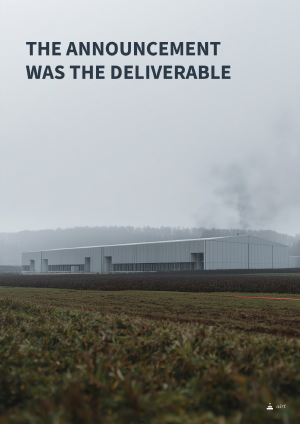
The Announcement Was the Deliverable
Download PDFThe Lanarkshire AI growth zone, and the gap between the purpose a system advertises and the one it performs.
In January 2026 the UK government announced an £8.2bn AI datacentre complex in Lanarkshire, built by the American firm CoreWeave and the Scottish company DataVita, and promised it would be powered from on-site renewables and running by 2030.1 Six months later an investigation by freelance journalist Aisha Down established through freedom of information requests that the site had no grid connection, that its renewable energy parks existed mostly as a website, and that within weeks of the announcement Scotland’s First Minister had been privately conceding to the developer the power problem the announcement waved away in public.2 DataVita’s own materials described energy parks “directly connected” to the datacentres, written in the present tense. Nothing was built.3 To supply the gigawatt it advertised, the site would need somewhere between forty and a hundred square kilometres of generation, on the investigation’s own range. It has applied for roughly two, and its parent’s one posted wind scheme, up to nineteen turbines, would cover a small fraction of it.4
The easy reading is bad faith, and it is the wrong one to reach for first. The grid is genuinely constrained, and the levers that might ease it sit at Westminster, not Holyrood. The political timetable is real and not of the officials’ making. Compute is mobile capital that will build in Virginia if Scotland hesitates. Against all that, wanting the announcement out, and out fast, is not cynicism; it is close to the rational move for someone who means it. The question is not whether anyone lied. It is what the machinery produces when everyone means well and only the announcement is rewarded.
The natural reading is that the planning system failed, and there is a strong case for it. Scotland’s National Planning Framework rests on an evidence base written in 2022, before ChatGPT existed, which never modelled the electricity demand of an AI datacentre.5 The consent DataVita holds for its Chapelhall site is a Permission in Principle, an instrument that grants the yes and defers the binding detail by design.6 Environmental impact assessments are mostly screened out: of the seven datacentre applications to reach this stage in Scotland, a countryside charity found five were told none was required.7 In Edinburgh this year a datacentre pitched itself as “green” to the council while its own plans showed rows of diesel backup generators, by that same charity’s count around two hundred of them. The planning committee could find no definition of a “green datacentre” in national policy to test the claim against, and refused the scheme only after its own planners had recommended approval.8 The word carries no statutory definition here, so it means whatever the applicant needs it to mean. On every count, the gate that should turn a promise into an enforceable obligation is standing open.
Everyone says the system is broken, which is the surest sign the words have stopped meaning one thing. “Not fit for purpose” holds three complaints whose cures run in opposite directions. To Westminster it is too slow: Rachel Reeves promises to back “the builders, not the blockers”, and the UK’s Planning and Infrastructure Bill takes powers to overrule councils and cut the time schemes spend in court; the cure is to strip the friction out, which is what a growth zone’s “planning support” is for.9 Holyrood sings the same tune a tone quieter, Kate Forbes pressing to shorten the wait for planning and consenting and declaring Scotland “open for business”, Swinney’s own letter to DataVita wanting the development to “proceed at pace”. To RTPI, the planners’ own institute, it is starved: expenditure down 33% in real terms since 2010, its workforce 10% down over five years, and is carrying 49 new duties nobody funded.10 Fee income rose by 38% in real terms over the same 14 years, but didn’t find its way back to support the increased workload with fewer staff.11 A third complaint is well evidenced: the system is toothless. Enforcing a planning condition is a discretionary act, and the obligation a developer accepts to win consent is not reliably delivered: in England, 17,432 affordable homes secured through section 106 agreements held detailed permission but remained uncontracted in October 2025, agreed and unbuilt.12a
Of the three, only the first is winning, and Lanarkshire is where it won. Nothing here was slow, because there was next to nothing to decide. One small consent came through on time; the flagship was announced with no application on file. The system’s quickest work was to say yes, and it asked for nothing back.
So calling it a failure smuggles in an assumption: that we agree what the system was for. Watch it against a different purpose. The press release counted 3,400 jobs and £8.2bn of investment, both figures, in the government’s own words, “supplied by DataVita as part of their proposals.”13 The community fund headlined at £543m holds, as of this summer, no money; it is to be filled from the company’s revenues, if it generates them.14 The jobs figure, a charity established under FOI, was lifted from estimates for a different site in Northumberland and multiplied up.15 The designation came stamped with its own escape clause, “conditional on delivery against agreed milestones”, left in the notes to editors.16 Every one of these is a failure if the goal was a working datacentre. None of them is a failure if the goal was the announcement. Measured against the press release, the system performed immaculately. The photo was taken, the number was banked, the minister moved on. The announcement was the deliverable.
The paperwork confirms it. On the day of the announcement the 500-megawatt datacentre at the heart of the zone had no planning application before the council at all, only a proposal-of-application notice, the form a developer files to say it intends to apply, lodged three weeks earlier. The one datacentre permission the company actually holds, on a separate plot nearby, is a Permission in Principle. On the planning register, the thing the government announced as delivered existed as a notice of intent.17
That Chapelhall consent bears this out to the letter. When North Lanarkshire granted it in January, it attached seventeen conditions, on coal-mining safety, contamination, noise, air quality, drainage, trunk-road visibility, parking, landscaping. Not one of them touches how the datacentre is to be powered. The renewable energy the whole scheme is sold on is not a condition of consent, not softened, not even deferred to the later-details stage; it simply is not the planning system’s concern. The single condition that gestures at decarbonisation asks only for a feasibility report on reusing the building’s waste heat, and a feasibility report is a study, not an outcome, discharged by the party who pays for it, sometimes by concluding the thing is not feasible, the same escape route that has quietly dissolved affordable-housing obligations in England for years.18
Lanarkshire is not the anomaly, it is the genre. The reporter who unpicked it had already found the UK’s flagship AI programme resting on what she called phantom investments: a £1.9bn contract the government announced and then never signed, a promised supercomputer that turned out to be a scaffolding yard.19 The machinery counts pledges at the moment of announcement and does not check them afterwards, because checking is not what the machinery is for. The social scientist Donald Campbell’s law holds that once an indicator becomes the basis for reward, institutions begin to optimise the indicator rather than the thing it was meant to measure.20 AI investment announcements look increasingly like that kind of metric. If ministers are rewarded for billions announced rather than datacentres connected to the grid, then the announcement ceases to describe delivery. It becomes the deliverable.
Blaming planning alone lets two larger culprits walk. The physical bottleneck is the grid. Around 100GW of datacentre projects sit in the connection queue, and because most cannot connect, more than a hundred are now asking to burn gas instead, some permanently, enough to put the 2030 target of keeping unabated gas below 5% out of reach.21 No planning reform shortens that queue. The levers that would, connection policy, energy strategy, are reserved to Westminster, while the consenting power that absorbs the consequences is devolved to Scotland. Planning looks like the root cause because it is the only lever within reach. A diagnosis that lands on the only thing you can touch deserves suspicion.
What Scotland nets
Set the £8.2bn aside and ask what reaches the public purse, what happens to bills, and how much of the money stays. The purse sees little, and the design intends it. Corporation tax on DataVita and CoreWeave is reserved to Westminster, and on a build this heavy in plant it is close to nil for years anyway, because full expensing lets a company write the whole of its qualifying kit off against profit in the year it is bought.22 The servers cancel the tax. What Holyrood can touch is non-domestic rates and Scottish income tax, and both are thin. Rates are devolved, but Scotland’s own Business Growth Accelerator Relief holds a new building off the roll until about a year after it opens and relieves the improvements after, so the state’s own hand lightens the bill.23 Income tax falls on the permanent staff, and a datacentre turns electricity into computation, not people into wages: a 500MW hall runs largely unmanned, on a few dozen technicians who come in to swap or rewire failed kit, not the thousands in the headline, most of which were construction and, the charity’s FOI showed, borrowed from a site in Northumberland.
Set beside England, Scotland captures less still. A designated English growth zone keeps every pound of its business-rates growth for 25 years; Scotland has arranged no such capture, so the recurring public revenue behind the £8.2bn banner is plausibly low tens of millions a year, unstateable more precisely because a datacentre that does not yet exist has no published rateable value.
Bills move the wrong way. A 500MW load bolted onto a constrained grid adds balancing and network cost, and that is spread across every bill, not the operator’s. The only discount actually on the table runs the other way: central Scotland’s datacentres, this one among them, are in line for up to £24 off each megawatt-hour of grid power from 2027, a saving for the datacentre, not the household.24 DataVita’s advertised low-cost power is its own private-wire cost, and where the public purse lowers an operator’s price that is a subsidy travelling one direction. The single arrangement that would let a datacentre lower the system’s cost, a flexible load that switches off when the wind drops and drinks it when it blows, is the one the application does not contain.
Most of the £8.2bn is ephemeral. It is a single self-supplied number spread across three components, datacentre halls, a 1GW renewables park and ‘innovation parks’ of labs and robotics, with no line-item split published and two of the three, the renewables and the innovation parks, still unbuilt.25 The one line with a real invoice is the chips, and it is a wasting one: NVIDIA silicon designed in California and fabricated in Taiwan, £1.5bn from an American operator, on a product line the maker now replaces yearly and that critics put at two or three years’ useful life, though the operator’s own books say six.26 It enters as Scottish investment and leaves as a purchase order abroad. Scotland keeps the concrete and the construction wages while they last, the land, a thin tail of power and maintenance, and the lightened rates. The computation is sold on to customers mostly elsewhere, and whatever profit survives is easy to move: the standard route is an intra-group licence fee, the local company paying not the operator but a sister company that owns the platform, the brand and the software and is domiciled wherever the tax is lowest, an IP box in Ireland or Luxembourg, a holding company in Bermuda or the Caymans, until the Scottish profit is a rounding error and the earnings surface somewhere they are barely taxed at all. Policing that, transfer pricing, diverted-profits rules, the global minimum rate, is a reserved matter, imperfectly enforced, and Scotland holds no share of whatever it recovers.
The £543m community fund, promised from revenues “if it generates them”, pegs the town’s benefit to reported local profit, the one figure a group this size has every legal means to minimise. Ordinary accountants save a company tens of millions; the structures open to a multinational save it hundreds, comfortably more than the fund is meant to hold. The fund and the Treasury are waiting on the same number, and it is the number the tax system is best at making small.
Look last at the transaction itself, the datacentre stripped out. What the developer spent to reach the announcement is small, and what it bought is durable. The planning fee was about £13,000 for the one consented site, a Permission in Principle over 1.8 hectares at Chapelhall, with even the 500MW flagship capped at around £93,000 when its application lands.27 That permission can sit unbuilt for five years before it lapses, an asset to hold, sell or develop as the grid queue allows, not a duty to build.28 The renewables remain a page on a website, the turbines a pre-planning sketch. Set the public side beside it, £5m and a government designation, and the shape is plain: the state gave the consent and the credibility at signing and took back promises that cost nothing to abandon.29 If the grid connection never comes, the developer keeps the consent and the headline. The public keeps the press release, rewritten as news.
If we weren’t starting from here
Ask what the state is actually buying, because the current strategy never does; it defaults to the only number in the room, the developer’s. For Scotland the thing worth buying is grid value and verified capability, not jobs; the jobs are mostly construction, and the headline was borrowed from another site. Decide that first and the conditions worth imposing follow; leave it undecided and you are bargaining over someone else’s press release.
So invert the failure: make the permission reversible, and check the promise before it counts. Verify before you announce. The state cites no figure it has not independently audited, and the ones that matter are binary: is the connection secured, is the land controlled, is the capital committed. That one rule ends the phantom-investment loop. It also takes the announcement away from the politician, which is exactly why it would be the hardest sentence in the bill to keep.
Stage the designation, and let it lapse. Growth-zone status stops being a single gift and becomes a sequence of gates, each releasing one benefit, planning help, then connection priority, then fiscal support, against one verified milestone: land assembled, connection secured, a first tranche of firm and renewable generation consented and financed. Miss a gate, lose the status. That is use-it-or-lose-it applied the whole way down, and it fits the connection reform the regulator is already attempting: order the queue by system value, and make the growth-zone prize a place in that order, granted only against real conditions. The developer who means it signs; the one selling a promise walks.
Condition only what cannot move. Compute is mobile and impatient; bind everything and it builds in Virginia while Scotland gets nothing, which is the real price of a reflexive refusal. So bind what cannot follow the data across the water: where the load sits, whether it can be interrupted, its call on the grid, the jurisdiction it answers to, and a public stake in the load itself. Leave nationality and local content alone, because those conditions break the procurement treaties Scotland is signed into.30 And give “green” a definition with teeth, so a shed ringed by diesel fails it on sight.
None of this is free, and pretending otherwise is how such schemes die on contact. Verification assumes a technical capacity the state has just shown it lacks; an independent infrastructure-assurance body, whose audited numbers are the only ones a minister may cite, is a new institution, slow to build and easy to capture. The reserved-devolved split means a clean Scottish design has to be assembled from the levers Holyrood actually holds, planning conditions, the consenting regime above fifty megawatts, procurement, public equity through the national investment bank, the same short list the country keeps arriving at. And there is a curve of conditionality no one can plot in advance: too few conditions and you are back to gifts, too many and the capital is already gone.
The hardest objection is the one that dissolves the complaint. All of this assumes the strategy is failing. It may be succeeding at a purpose it never prints. If the point is to be seen to win the AI race, to signal to mobile capital that Scotland is open for it before a rival does, then press-release industrial strategy is not broken. It is optimal. To call it a failure quietly assumes we agree on the purpose, and the evidence is that we do not. The system serves the announcement perfectly. It fails only against the purpose written on the tin.
Which leaves the reform that actually matters, and it is not a planning reform. It is to make the advertised purpose the real one, by making delivery, not announcement, the thing that pays. Until a minister loses more from an unbuilt datacentre than from an unannounced one, the announcement will remain the deliverable.
airt.scot.
UK Gov press release, Lanarkshire AI Growth Zone, 29 Jan 2026 (£8.2bn, CoreWeave + DataVita, “drawn from on-site renewables”, by 2030). ↩︎
Aisha Down, “Revealed: landmark Scottish AI project has no prospect of meeting renewables promise”, 6 Jul 2026 (NESO FOI = no connection; AIGZ criteria unmet, designated anyway; Swinney’s Feb letter concedes “power provision remains a key issue”). ↩︎
DataVita, “Over 1GW of Private Wire Renewables” / “directly connected to our data centres” (present tense; “First energy parks operational Q1 2028”). ↩︎
40-100 sq km of generation needed vs “less than a 10th” held (Down, 6 Jul); ~2 sq km applied; parent HFD’s posted scheme “up to 19 wind turbines”, a small fraction of the advertised renewable capacity. ↩︎
NPF4 states green datacentres will have an “overall negligible impact” on emissions targets; the underlying analysis dates from 2022, before ChatGPT, and assumed any datacentre emissions would be offset by reduced commuting, with AI load unmodelled (Aisha Down, “Scotland’s ‘green datacentres’ policy ignores emissions impact of AI”, Guardian, 25 May 2026, reporting APRS). ↩︎
The one permitted datacentre consent, “Data Centre including Associated Plant”, Land Adjacent to York Road, Chapelhall (a 1.8ha business-zoned parcel, an extension to DataVita’s existing York Road centre, a different and smaller site from the 500MW South Lanridge one), is a Permission in Principle (25/01159/PPP), permitted 9 Jan 2026. A PPP grants the principle and defers detailed matters to a later stage. ↩︎
Action to Protect Rural Scotland audit of Scottish planning portals: five of the seven datacentre applications to reach this stage were not required to carry out an EIA, including the Edinburgh greenbelt site at Currie (aprs.scot, 2 Feb 2026). The Gyle datacentre’s no-EIA screening was challenged as potentially unlawful by the Environmental Rights Centre for Scotland; the council reconsidered the screening and returned the same verdict. ↩︎
The Gyle datacentre (former RBS HQ, South Gyle; application 25/04239/PPP, ~210MW, Shelborn Asset Management) marketed itself as “green” while its own air-quality assessment identified diesel backup generators; APRS calculated the site would need over two hundred, burning diesel equivalent to ~106,000 idling cars. City of Edinburgh Council planning officers recommended approval; the Development Management Sub-Committee refused permission in principle on 5 Feb 2026, both officers and members conceding NPF4 carries no definition of a “green datacentre”. (The Register, 10 Feb 2026; APRS, 2 Feb 2026; Aisha Down, Guardian, 25 May 2026, who reported the committee “appeared to have accepted this definition … while conceding there was no definition”.) ↩︎
Rachel Reeves, “back the builders, not the blockers”, the UK government’s framing for the Planning and Infrastructure Bill / “pro-growth package … to get Britain building” (gov.uk, 2025; Housing Secretary call-in powers over councils and curbs on judicial review, expanded Oct 2025). Kate Forbes (Deputy FM, Economy) on shortening planning and consenting waiting times and Scotland being “open for business” (SNP conference, 30 Aug 2024). John Swinney to DataVita: the development to “proceed at pace”. ↩︎
RTPI Scotland: planning expenditure is down 33% in real terms between 2010 and 2024 (State of the Profession 2025), the local authority staff down 10% from 2019 to 2023 (Resourcing the Planning Service 2023), it claims 49 unfunded duties added by the Planning (Scotland) Act 2019, and asks for a long-term budget commitment to fund the service (Planifesto 2026). ↩︎
RTPI Scotland, State of the Profession 2025: income rose 38% in real terms over the same years, and “although income generated by planning services increased, this was not reflected with increased spending on them”. ↩︎
In England, 17,432 affordable homes secured through section 106 planning agreements held detailed permission but remained uncontracted, the obligations agreed to win consent but left undelivered (Home Builders Federation, “Uncontracted Section 106 Affordable Homes”, October 2025). ↩︎
“Jobs and investment figures have been supplied by DataVita as part of their proposals” (UK Gov press release, notes). ↩︎
“no money currently in the £543m community fund … planned to come from DataVita revenues, if it generates them” (Down, 6 Jul 2026). ↩︎
APRS FoI: the 3,400 jobs figure taken from Cambois (Northumberland) estimates and multiplied (Down, 6 Jul 2026; APRS employment report). ↩︎
“AI Growth Zone status is conditional on delivery against agreed milestones … subject to the site continuing to meet agreed criteria” (UK Gov press release, notes to editors). ↩︎
North Lanarkshire planning portal (eplanning.northlanarkshire.gov.uk). South Lanridge, the ~500MW datacentre site, is 25/01328/PAN, a Proposal of Application Notice (pre-application, NOT a planning application) validated 8 Jan 2026. The 12-week pre-application consultation began that day, so the earliest a planning application could be lodged was after 2 April 2026; the growth zone was announced 29 Jan 2026, when no application existed and none could yet be made. The council’s proposal text lists “substation, and battery energy storage and generation” (BES >50MW routing to the SG Energy Consents Unit); the location plan shows greenfield farmland on Linrigg Road, ~1km east of the Newarthill industrial edge. ↩︎
North Lanarkshire delegated report + decision notice for 25/01159/PPP attached 17 conditions, covering MSC reserved matters (siting/design/access/layout/landscaping/biodiversity/boundary/platform/noise/air/sewage), coal-mining site investigation + remediation, contamination/mine-gas, CEMP, trunk-road lighting/landscaping/fencing/no-drainage, Noise + Air Quality impact assessments, transport/parking, and SUDS. None binds the renewable power. Condition 17 is the sole decarbonisation item: “a feasibility report on the provision of appropriate infrastructure to service a heat network outwith the application site” (waste-heat reuse), its stated reason “In the interests of decarbonised solutions to heat and cooling demand”. The feasibility-as-escape parallel to the s106 viability route is discussed in the note on uncontracted section 106 obligations above. ↩︎
Aisha Down, “Revealed: UK’s multibillion AI drive is built on ‘phantom investments’”, Guardian, 9 Mar 2026. The government (DSIT) acknowledged “there was no contract in place for a £1.9bn ($2.5bn) investment despite a press release declaring that one had been signed”: Nscale’s Loughton, Essex “supercomputer”, which the Guardian found in February 2026 was still a scaffolding yard, with Nscale not registered as owner of the site. (A 23 Mar 2026 Guardian footnote records Nscale then stating it bought the Loughton site in September 2025 and now aims to deliver in 2027.) ↩︎
Donald T. Campbell, “Assessing the Impact of Planned Social Change” (The Public Affairs Center, Dartmouth College, Occasional Paper #8, December 1976; reprinted in Evaluation and Program Planning 2, no. 1 (1979): 67-90). Campbell offered it as one of his own “pessimistic laws (at least for the U.S. scene)”: “the more any quantitative social indicator is used for social decision-making, the more subject it will be to corruption pressures and the more apt it will be to distort and corrupt the social processes it is intended to monitor.” ↩︎
~100GW in the connection queue (Ofgem’s Stuart Okin); 100+ datacentre gas-connection requests, >15 TWh/yr, “over 100MW … permanent”; NESO’s Julian Leslie on the <5% unabated-gas Clean Power 2030 target (Down, Guardian, 18 May 2026). ↩︎
Full expensing, a 100% first-year allowance on qualifying plant, permanent since the Autumn Statement 2023 (HMRC / gov.uk). Corporation tax is reserved to HMRC, not Scottish Government revenue. ↩︎
Scotland’s Business Growth Accelerator Relief: no non-domestic rates for 12 months after a new build enters the valuation roll, plus relief on improvements (mygov.scot). ↩︎
DSIT proposal (announced 18 Nov 2025) to cut grid electricity costs for central-Scotland datacentres by up to £24/MWh, funded by recycling constraint-payment costs; the UK government states the approach “would not increase costs for other electricity bill payers” (DataCentreNews UK, reporting the DSIT proposal, 18 Nov 2025). The “from April 2027” start date rests on a law-firm briefing; the £24 figure and central-Scotland scope are the DSIT proposal. ↩︎
The £8.2bn is DataVita’s own figure, presented as three components, ~500MW of datacentre capacity, “more than 1GW” of private-wire renewables, and “Innovation Parks” (laboratory, robotics and advanced-manufacturing space), with CoreWeave’s ~£1.5bn the compute. No line-item split is published and every figure is “supplied by DataVita”. ↩︎
NVIDIA now ships a new datacentre GPU generation yearly (Hopper 2022, Blackwell 2024, Rubin 2026). CoreWeave books a six-year depreciation life; critics (Michael Burry among them) put the real economic life at two to three years, efficiency gains retiring older chips on running cost. Contested: CoreWeave defends the six years (2020 A100s still booked). ↩︎
TCP (Fees for Applications) (Scotland) Regs 2022 as amended by SSI 2026/49, Table 2 (Permission in Principle), cat 2: £742 per 0.1 hectare to 2.5ha, cap £92,762 (as at 2026). Chapelhall 1.8ha ≈ £13,356 at current rates; fee actually paid depends on the rate SSI in force at application (submitted 2025). ↩︎
Town and Country Planning (Scotland) Act 1997 s.59(2A)-(2C) (as substituted by the Planning (Scotland) Act 2019 s.32(4), in force 1 Oct 2022): a Permission in Principle must be begun within 5 years of grant, or such other period as the authority specifies, or it lapses. Chapelhall was granted on 9 January 2026. ↩︎
“Scotland’s AI Growth Zone, backed by £5 million of UK government investment” (Scotland Office minister Kirsty McNeill, UK Gov press release, 29 Jan 2026); the £543m community fund is “raised as data centre capacity comes online”. ↩︎
WTO GPA Art IV + Public Contracts (Scotland) Regs 2015 / PRSA 2014: conditions must be functional, not nationality-based. ↩︎